
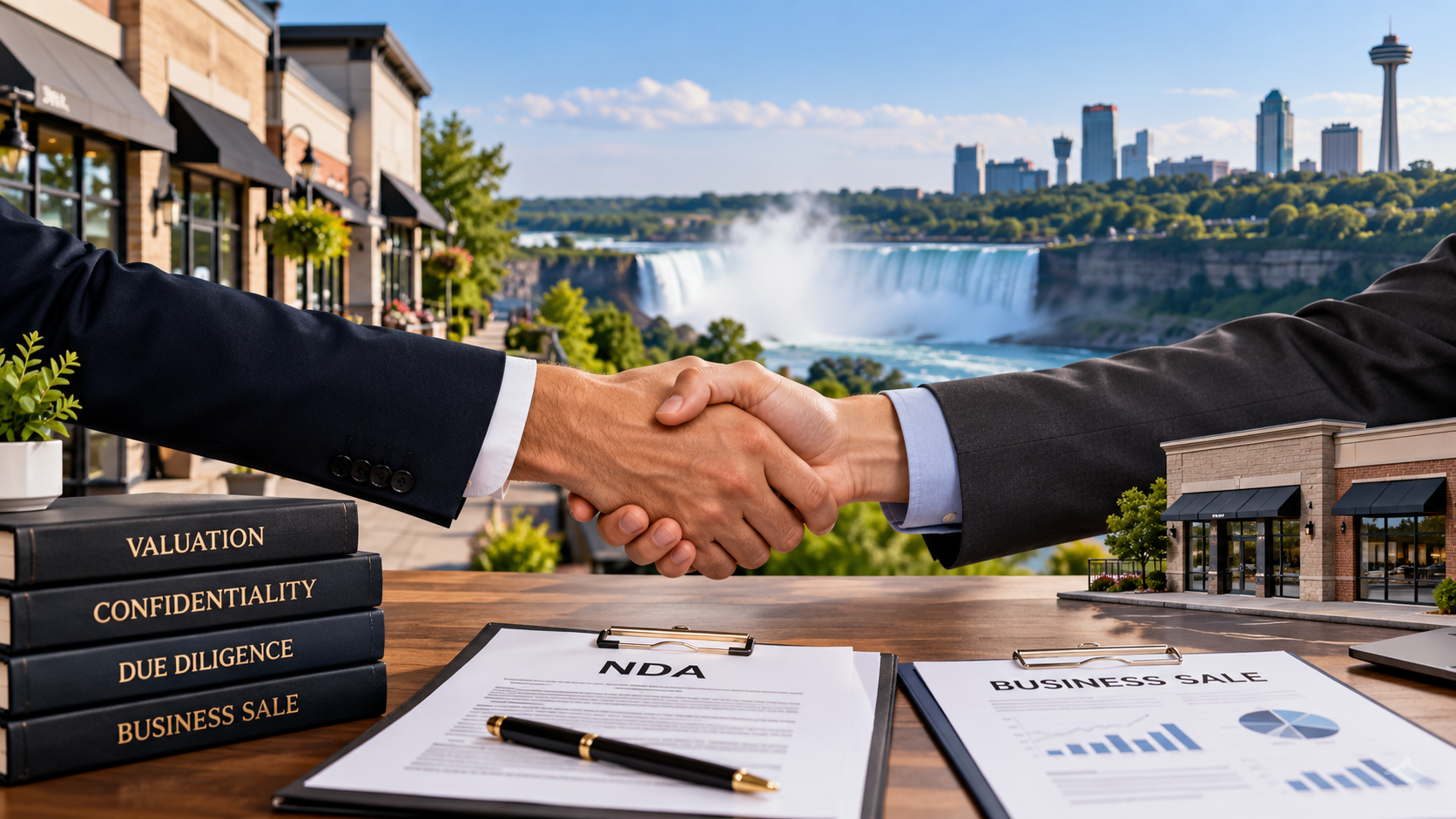
KEY TAKEAWAYS & EXECUTIVE SUMMARY
- Selling a small business in Niagara requires a proactive 6 to 12 month preparation timeline to normalize financial statements and maximize valuation multiples.
- Owner-operated businesses with under $5 million in revenue are typically valued on a multiple of Seller Discretionary Earnings (SDE), trading between 2.0x and 4.0x SDE.
- Confidentiality is critical. Inquiries must be screened using blind marketing profiles, and detailed records are only disclosed after receiving a fully executed Non-Disclosure Agreement (NDA).
- Sellers must decide whether to sell company-owned commercial real estate as part of the business transaction, retain the property as a landlord, or execute a sale-leaseback.
- Structuring the transaction as an asset sale versus a share sale creates profound tax implications, including eligibility for the Lifetime Capital Gains Exemption (LCGE).
Planning Your Business Exit in Niagara
For most independent business owners in the Niagara Region, their company represents decades of sacrifice, reinvestment, and personal dedication. Whether you own a high-volume restaurant along the Niagara tourist strip, a boutique retail establishment in Niagara-on-the-Lake, an automotive service center in St. Catharines, or a light manufacturing facility in Welland, selling your enterprise is a major financial milestone.
Yet selling a private business is fundamentally different from selling residential real estate. If your staff, customers, or suppliers discover that your business is for sale prematurely, customer confidence can waver, staff may seek alternate employment, and competitors can take advantage. As a licensed real estate professional specializing in commercial transactions with Quantum Team Realty, Brokerage, I provide confidential representation that protects your operations while securing top enterprise value.
Valuation Fundamentals: SDE vs. EBITDA Explained
A business is not valued on hope or emotional attachment; it is valued on normalized future cash flow and risk. In Ontario, commercial valuation relies on two primary metrics:

| Valuation Metric | Typical Business Type | Financial Calculation Method | Typical Niagara Multiple Range |
|---|---|---|---|
| Seller Discretionary Earnings (SDE) | Owner-operated small businesses (under $5M revenue) | Net Profit + Owner Salary + Perks + Discretionary Expenses | 2.0x–4.0x SDE Depending on industry stability and lease term |
| EBITDA Multiple | Larger businesses with general management in place | Earnings Before Interest, Taxes, Depreciation & Amortization | 4.0x–6.5x EBITDA Higher multiples may apply to businesses with recurring contracts |
The Financial Recasting Process (Normalization)
Most small business owners minimize their corporate taxable income through legal deductions: vehicle expenses, mobile phones, travel conferences, and family compensation. While this reduces corporate income tax, it artificially suppresses the reported profitability of the business on paper. Before marketing your business, I assist you in ‘recasting’ your financial statements for the past 3 to 5 years. We identify verified add-backs and non-recurring expenses to present a true, defensible picture of total owner benefit to prospective buyers and commercial lenders.
The Confidentiality Protocol: Protecting Your Operations
How do we market a business without revealing its identity to the public? We execute a strict four-stage confidentiality funnel:
The Blind Profile (Teaser)
I prepare a confidential marketing summary that outlines the business type, general Niagara location, revenue range, and growth opportunities without revealing its name, exact address, or identifying branding. This helps attract potential buyers while protecting your business identity.
Buyer Vetting & Signed NDA
Before sharing sensitive business information, I screen interested buyers and may request identification and evidence of financial capability. Qualified prospects must sign an appropriate Non-Disclosure Agreement (NDA) before receiving confidential records, helping protect your financial information and day-to-day operations.
Confidential Information Memorandum (CIM)
Once a buyer has passed the screening process, I help coordinate access to a detailed business information package. Depending on the transaction, it may include normalized financial statements, lease terms, equipment inventories, staffing information, and key operational details needed for informed due diligence.
Controlled Private Showings
I coordinate private business visits with qualified prospects at carefully arranged times, often outside regular operating hours where appropriate. This helps minimize disruption to employees and customers while allowing serious buyers to assess the business and discuss the opportunity discreetly.

What Happens to the Commercial Real Estate?
If your operating company owns the underlying commercial property (such as a standalone building or industrial unit), you have three strategic paths to consider:
Sell the Business & Property Together
The buyer acquires both your operating business and the commercial property in one transaction. I'll help you understand how the business and real estate are valued separately as you explore this option.
Keep the Property & Become a Landlord
You sell the operating business but retain ownership of the building. Leasing the property to the new owner may provide ongoing rental income, subject to the lease terms, expenses, and tenant arrangements.
Explore a Sale-Leaseback
You sell the commercial property to an investor and lease it back for continued business operations. This may release equity tied up in the property while allowing the business to remain at its current location, subject to the negotiated lease terms.
Structuring the Deal: Asset Sale vs. Share Sale
The legal structure of the sale dramatically influences the net after-tax proceeds you keep in your bank account:

Asset Sale Structure
The buyer purchases selected business assets rather than acquiring shares in the company.
What may be included?
- Inventory and equipment
- Machinery and business assets
- Customer lists and goodwill
- Business names and other agreed assets
The agreement specifies which assets and liabilities transfer. Liabilities not assumed by the buyer may remain with the seller or selling company.
Share Sale Structure
The buyer acquires shares in the incorporated company, subject to the agreed transaction terms.
What does this mean?
- Ownership of the corporation changes
- The company generally retains its assets
- Existing corporate liabilities remain within the company
- Tax treatment depends on the transaction structure
Qualifying shares of a Canadian-controlled private corporation may be eligible for the Lifetime Capital Gains Exemption (LCGE), subject to applicable requirements and limits.
Frequently Asked Questions About Selling a Small Business
How long does it take to sell a business in Ontario?
On average, selling an established small business takes between 6 and 9 months. Preparation, financial recasting, buyer vetting, due diligence, and commercial lease assignments all require structured time.
Do I need the landlord's approval to sell my business?
Yes. If your business operates in a leased retail plaza or commercial warehouse, the landlord must consent to assigning the lease to the incoming purchaser. Having clean lease renewal options is essential to securing financing.
What is a blind business profile?
A blind profile describes the financial highlights and industry sector of a business without disclosing its name, exact address, or identifying details, ensuring total operational privacy.
Next Steps: Book a Confidential Business Valuation Review
If you are considering a business succession plan or exit strategy in the next 1 to 3 years, starting early ensures your financials and lease covenants are positioned for maximum value. Contact me directly at (647) 906-9086 or via arzman.ca for a private, confidential discussion covered under full mutual non-disclosure.

I'm Arzman Singh.
I'm a Niagara-based realtor with Quantum Team Realty, helping buyers, sellers, landlords, and investors make informed real estate decisions. I combine local market knowledge with practical advice and a hands-on approach to help you understand your options and move forward with confidence.